
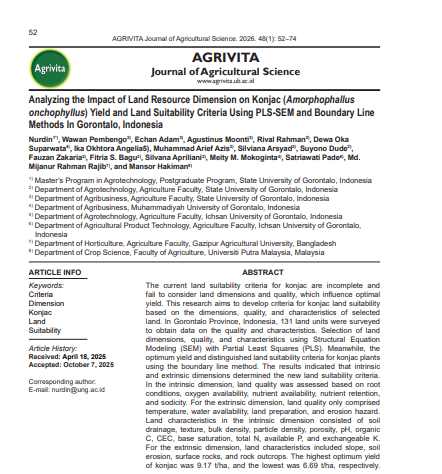
Analyzing the Impact of Land Resource Dimension on Konjac (Amorphophallus onchophyllus) Yield and Land Suitability Criteria Using PLS-SEM and Boundary Line Methods In Gorontalo, Indonesia

Nurdin1*), Wawan Pembengo2), Echan Adam3), Agustinus Moonti3), Rival Rahman2), Dewa Oka Suparwata4), Ika Okhtora Angelia5), Muhammad Arief Azis2), Silviana Arsyad2), Suyono Dude2), Fauzan Zakaria2), Fitria S. Bagu2), Silvana Apriliani2), Meity M. Mokoginta4), Satriawati Pade6), Md. Mijanur Rahman Rajib7), and Mansor Hakiman8)
1) Master’s Program in Agrotechnology, Postgraduate Program, State University of Gorontalo, Indonesia
2) Department of Agrotechnology, Agriculture Faculty, State University of Gorontalo, Indonesia
3) Department of Agribusiness, Agriculture Faculty, State University of Gorontalo, Indonesia
4) Department of Agribusiness, Muhammadiyah University of Gorontalo, Indonesia
5) Department of Agrotechnology, Agriculture Faculty, Ichsan University of Gorontalo, Indonesia
6) Department of Agricultural Product Technology, Agriculture Faculty, Ichsan University of Gorontalo, Indonesia
7) Department of Horticulture, Agriculture Faculty, Gazipur Agricultural University, Bangladesh
8) Department of Crop Science, Faculty of Agriculture, Universiti Putra Malaysia, Malaysia
Abstract
The current land suitability criteria for konjac are incomplete and fail to consider land dimensions and quality, which influence optimal yield. This research aims to develop criteria for konjac land suitability based on the dimensions, quality, and characteristics of selected land. In Gorontalo Province, Indonesia, 131 land units were surveyed to obtain data on the quality and characteristics. Selection of land dimensions, quality, and characteristics using Structural Equation Modeling (SEM) with Partial Least Squares (PLS). Meanwhile, the optimum yield and distinguished land suitability criteria for konjac plants using the boundary line method. The results indicated that intrinsic and extrinsic dimensions determined the new land suitability criteria. In the intrinsic dimension, land quality was assessed based on root conditions, oxygen availability, nutrient availability, nutrient retention, and sodicity. For the extrinsic dimension, land quality only comprised temperature, water availability, land preparation, and erosion hazard. Land characteristics in the intrinsic dimension consisted of soil drainage, texture, bulk density, particle density, porosity, pH, organic C, CEC, base saturation, total N, available P, and exchangeable K. For the extrinsic dimension, land characteristics included slope, soil erosion, surface rocks, and rock outcrops. The highest optimum yield of konjac was 9.17 t/ha, and the lowest was 6.69 t/ha, respectively.
Keywords: Criteria; Dimension; Konjac; Land; Suitability
Kategori
- Abstract 2006
- Abstract 2009
- Abstract 2011
- Abstract 2012
- Abstract 2013
- Abstract 2014
- Abstract 2016
- Abstract 2018
- Abstract 2019
- Abstract 2020
- Abstract 2021
- Abstract 2022
- Abstract 2023
- Abstract 2024
- Abstract 2025
- Abstract 2026
- Buku
- Kunjungan Luar Negeri
- Mata Kuliah
- Pengukuhan Guru Besar, Prof. Dr. Nurdin, SP, MSi
- Profesi Ir
- Project 2009
- Project 2010
- Project 2013
- Project 2018
- Project 2019
- Project 2020
- Project 2021
- Project 2022
- Project 2023
- Project 2024
- Project 2025
- Publikasi Ilmiahku
- Soil Scientist from Gorontalo
- Tugas Pembantuan sebagai Kepala Dinas Pertanian Kabupaten Boalemo
Arsip
Blogroll
- a-SintaID
- b-Google Scholar
- c-Scopus ID
- d-Web of Science (WoS) ID
- e-ResearchGate
- f-Academia.edu
- g-SciProfiles
- h-Loop ID
- i-LinkedIn
- j-OrcidID
- k-figshare
- l-Youtube
- m-Twitter
- n-Facebook
- o-Universitas Negeri Gorontalo
- p-BIMA-Kemendikbud RI
- q-FAPERTA UNG
- r-LP2M UNG
- s- LP3M UNG
- t-SIMPPM UNG
- u-SIMLIT UNG
- v-Rispro LPDP
- w-BRIIN
- x-PDDIKTI
- y-GRS BPDPKS
- z-kampusmerdeka
- z1-ANJANI
- z10-MyASN
- z10-SIAT UNG
- z11-Aplikasi SIAGA
- z12-SPADA Indonesia
- z13-SISTER
- z14-tesaurus.kemdikbud
- z15-UKBI
- z16-typoonline
- z17-Turnitin
- z18-Zetero
- z2-eHAKI
- z20-Himpunan Ilmu Tanah Indonesia(HITI)
- z21-BKN
- z21-Kementan RI
- z22-BPS Provinsi Gorontalo
- z23-BPS Kabupaten Boalemo
- z24-BPS Kabupaten Bone Bolango
- z25-BPS Kabupaten Gorontalo
- z26-BPS Kabupaten Gorontalo Utara
- z27-BPS Kabupaten Pohuwato
- z3-Arjuna
- z4-DIKTI
- z5-GARUDA Dikti
- z6-SIM Karier dan SDM Kemendikbud
- z7-KBBI
- z8-Kedaireka
- z9-RAMA