
The Relationship Between Land Characteristics and Quality with Land and Crop Management
JOURNAL OF AGRICULTURAL TECHNOLOGYAND NATURAL FARMING
Irma Abdul Rahman1, Djaria Dalanggo1, Inang Jafar1, Nurdin2, Nurmi3
1Mahasiswa, Universitas Negeri Gorontalo
2Dosen Pengampuh Mata Kuliah, Universitas Negeri Gorontalo
3Dosen Pengampuh Mata Kuliah, Universitas Negeri Gorontalo
E-mail Korespondensi: irmaabdulrahman09@gmail.com
ABSTRACT
Land characteristics and quality are fundamental factors determining the success of land and crop management in agricultural systems. Understanding the relationship between them is key to designing appropriate, efficient, and sustainable management strategies. This review article is compiled to comprehensively examine the relationship between land characteristics and quality with land and crop management based on synthesis from various previous studies. A systematic literature search was conducted on selected scientific journals relevant to the review topic. This review reveals that land characteristicsincluding physical, chemical, and biological soil properties directly influence land quality which in turn determines land suitability for various crop types and crop responses to management inputs. Land management such as tillage, fertilization, irrigation, and conservation must be tailored to site-specific land characteristics and quality to optimize productivity while maintaining land resource sustainability. Land quality assessment through land evaluation approaches becomes an important instrument in determining land use directions and appropriate management recommendations. This review is expected to serve as a useful academic reference for students, researchers, and practitioners in understanding the reciprocal relationship between land characteristics, land quality, and management practices to achieve sustainable agriculture.
Keywords:land characteristics, land quality, land management, crop management, land evaluation.
A Review of Urban Sprawl Concept: Characteristics, Causes, and Impacts on Agricultural Land
JOURNAL OF AGRICULTURAL TECHNOLOGYAND NATURAL FARMING
Rahmiyati Modjo1, Rahmawaty Amir Isa1, Yulian Lamato1, Nurdin2, Nurmi3
1Mahasiswa, Universitas Negeri Gorontalo
2Dosen Pengampuh Mata Kuliah, Universitas Negeri Gorontalo
3Dosen Pengampuh Mata Kuliah, Universitas Negeri Gorontalo
E-mail Korespondensi: rahmimodjo03@gmail.com
ABSTRACT
Urban sprawl or uncontrolled urban development into peri-urban areas has become a global phenomenon threatening the sustainability of productive agricultural land. This review article is compiled to provide a comprehensive overview of the concept of urban sprawl, its development characteristics, causal factors, and impacts on agricultural land based on literature reviews from various previous studies. A systematic literature searchwas conducted on selected scientific journals relevant to the review topic. The review reveals that urban sprawl is characterized by unplanned development patterns with ribbon development types (elongated following transportation corridors) and leapfrog development (discontinuous jumps), low density, and fragmentation of agricultural landscapes. Factors causing urban sprawl include population growth and urbanization, economic factors and land values, weak spatial planning policies, household behavior, and accessibility and infrastructure. The impacts of urban sprawl on agricultural land are significant, including conversion of productive agricultural land, land fragmentation, decreased food production, threats to food security, disruption of irrigation systems, and socio-economic impacts on farmers. This review is expected to serve as a useful academic reference for students, researchers, and practitioners in understanding urban sprawl phenomena and formulating control policies to protect agricultural land.
Keywords:urban sprawl, agricultural land, land conversion, peri-urban areas, spatial planning
Analysis of the Potential and Conditions of the Buffalo Business Development Area in the South Coastal Area of the Greater Manggarai Area

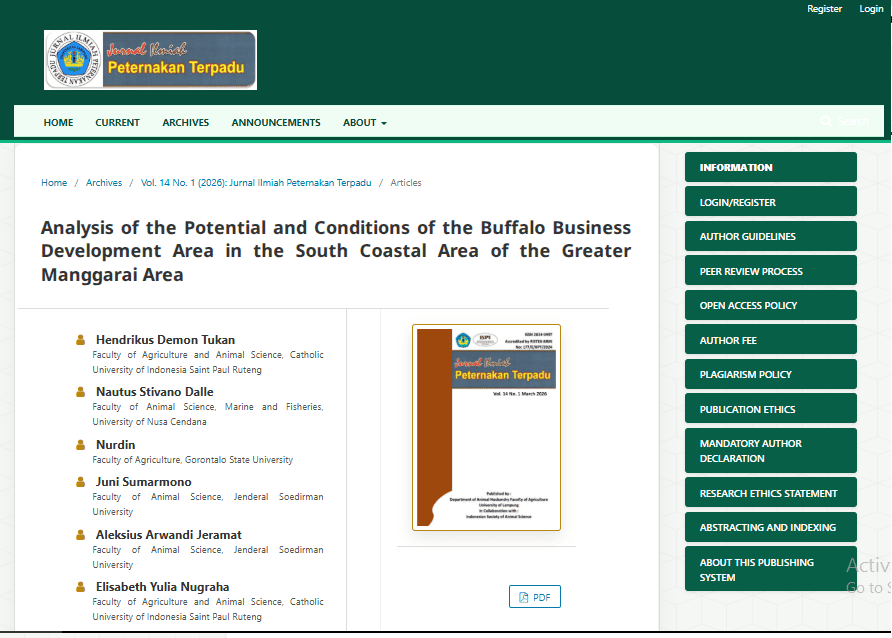
Hendrikus Demon Tukan (Faculty of Agriculture and Animal Science, Catholic University of Indonesia Saint Paul Ruteng)
Nautus Stivano Dalle (Faculty of Animal Science, Marine and Fisheries, University of Nusa Cendana)
Nurdin (Faculty of Agriculture, Gorontalo State University)
Juni Sumarmono (Faculty of Animal Science, Jenderal Soedirman University)
Aleksius Arwandi Jeramat (Faculty of Animal Science, Jenderal Soedirman University)
Elisabeth Yulia Nugraha (Faculty of Agriculture and Animal Science, Catholic University of Indonesia Saint Paul Ruteng)
Abstract
The aim of this study is to analyze the density of buffalo livestock in the southern coastal area of Greater Manggarai based on the calculation of Location Quotient (LQ), to analyze the factors that influence farmers in the existence of buffalo livestock. This research was conducted from December 2024 to May 2025 in the southern coastal area of Greater Manggarai spread across 7 sub-districts, namely: Lembor, South Lembor, Satar Mese, West Satar Barat, Borong, Komba City, and North Komba sub-districts. The research method used in this study was livestock density calculation, LQ analysis, and influence factor analysis using multiple linear regression with SSPS 18 as a tool. The results of the study indicate that the majority of the southern region of the Greater Manggarai area is not a base for buffalo livestock, but in terms of potential and topography, the region is very supportive from the economic, socio-cultural and traditional aspects. The results of the analysis of the potential and condition of the region and the density of buffalo livestock can be symbolized that the priority for buffalo livestock development is in the Kota Komba and Lembor Selatan sub-districts, followed by Lembor and Borong sub-districts. For the specific development of buffalo livestock commodities, based on the results of the LQ analysis, the potential base for buffalo livestock development is in the Lembor Selatan and Kota Komba sub-districts. The most dominant influencing factor in the analysis of the potential and condition of the buffalo livestock development area in the southern region of the Greater Manggarai area is the socio-cultural factor.
Land Suitability Evaluation of Maize Crop in Tilamuta Ditrict of Boalemo Regency


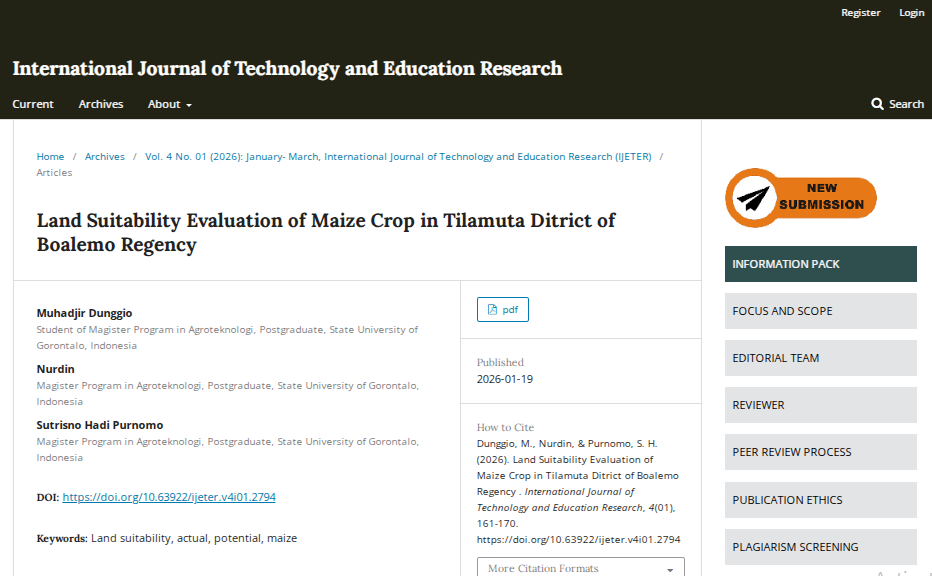
Muhadjir Dunggio (Student of Magister Program in Agroteknologi, Postgraduate, State University of Gorontalo, Indonesia)
Nurdin (Magister Program in Agroteknologi, Postgraduate, State University of Gorontalo, Indonesia)
Sutrisno Hadi Purnomo (Magister Program in Agroteknologi, Postgraduate, State University of Gorontalo, Indonesia)
Abstract
This study aims to determine the land suitability class and limiting factors for maize (Zea mays L.) in Tilamuta District, Boalemo Regency. The study will take place from August 2025 to September 2025 in Tilamuta District, Boalemo Regency. The method used in this study is the matching method, or matching between land characteristics and quality with the criteria for maize land suitability. The results of the analysis show that the actual land suitability for maize plants in Tilamuta District, Boalemo Regency, is in the marginal suitability class (S3) and is spread across all land units. This condition is influenced by several main limiting factors, namely low nutrient availability, rainfall, soil nutrient retention capacity, slope gradient, and erosion hazard levels. However, for potential land suitability, the application of various improvement efforts such as fertilization, liming, adding organic materials, implementing a planting system that follows the contour, and intensive terracing can increase the land suitability class to fairly suitable (S2).
Keywords: Land suitability, actual, potential, maize
Analyzing the Impact of Land Resource Dimension on Konjac (Amorphophallus onchophyllus) Yield and Land Suitability Criteria Using PLS-SEM and Boundary Line Methods In Gorontalo, Indonesia


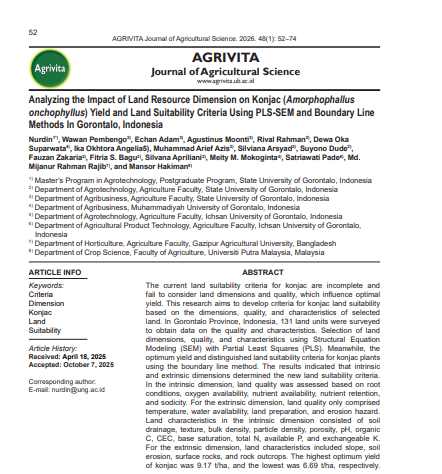
Nurdin1*), Wawan Pembengo2), Echan Adam3), Agustinus Moonti3), Rival Rahman2), Dewa Oka Suparwata4), Ika Okhtora Angelia5), Muhammad Arief Azis2), Silviana Arsyad2), Suyono Dude2), Fauzan Zakaria2), Fitria S. Bagu2), Silvana Apriliani2), Meity M. Mokoginta4), Satriawati Pade6), Md. Mijanur Rahman Rajib7), and Mansor Hakiman8)
1) Master’s Program in Agrotechnology, Postgraduate Program, State University of Gorontalo, Indonesia
2) Department of Agrotechnology, Agriculture Faculty, State University of Gorontalo, Indonesia
3) Department of Agribusiness, Agriculture Faculty, State University of Gorontalo, Indonesia
4) Department of Agribusiness, Muhammadiyah University of Gorontalo, Indonesia
5) Department of Agrotechnology, Agriculture Faculty, Ichsan University of Gorontalo, Indonesia
6) Department of Agricultural Product Technology, Agriculture Faculty, Ichsan University of Gorontalo, Indonesia
7) Department of Horticulture, Agriculture Faculty, Gazipur Agricultural University, Bangladesh
8) Department of Crop Science, Faculty of Agriculture, Universiti Putra Malaysia, Malaysia
Abstract
The current land suitability criteria for konjac are incomplete and fail to consider land dimensions and quality, which influence optimal yield. This research aims to develop criteria for konjac land suitability based on the dimensions, quality, and characteristics of selected land. In Gorontalo Province, Indonesia, 131 land units were surveyed to obtain data on the quality and characteristics. Selection of land dimensions, quality, and characteristics using Structural Equation Modeling (SEM) with Partial Least Squares (PLS). Meanwhile, the optimum yield and distinguished land suitability criteria for konjac plants using the boundary line method. The results indicated that intrinsic and extrinsic dimensions determined the new land suitability criteria. In the intrinsic dimension, land quality was assessed based on root conditions, oxygen availability, nutrient availability, nutrient retention, and sodicity. For the extrinsic dimension, land quality only comprised temperature, water availability, land preparation, and erosion hazard. Land characteristics in the intrinsic dimension consisted of soil drainage, texture, bulk density, particle density, porosity, pH, organic C, CEC, base saturation, total N, available P, and exchangeable K. For the extrinsic dimension, land characteristics included slope, soil erosion, surface rocks, and rock outcrops. The highest optimum yield of konjac was 9.17 t/ha, and the lowest was 6.69 t/ha, respectively.
Keywords: Criteria; Dimension; Konjac; Land; Suitability
Kategori
- Abstract 2006
- Abstract 2009
- Abstract 2011
- Abstract 2012
- Abstract 2013
- Abstract 2014
- Abstract 2016
- Abstract 2018
- Abstract 2019
- Abstract 2020
- Abstract 2021
- Abstract 2022
- Abstract 2023
- Abstract 2024
- Abstract 2025
- Abstract 2026
- Buku
- Kunjungan Luar Negeri
- Mata Kuliah
- Pengukuhan Guru Besar, Prof. Dr. Nurdin, SP, MSi
- Profesi Ir
- Project 2009
- Project 2010
- Project 2013
- Project 2018
- Project 2019
- Project 2020
- Project 2021
- Project 2022
- Project 2023
- Project 2024
- Project 2025
- Publikasi Ilmiahku
- Soil Scientist from Gorontalo
- Tugas Pembantuan sebagai Kepala Dinas Pertanian Kabupaten Boalemo
Arsip
Blogroll
- a-SintaID
- b-Google Scholar
- c-Scopus ID
- d-Web of Science (WoS) ID
- e-ResearchGate
- f-Academia.edu
- g-SciProfiles
- h-Loop ID
- i-LinkedIn
- j-OrcidID
- k-figshare
- l-Youtube
- m-Twitter
- n-Facebook
- o-Universitas Negeri Gorontalo
- p-BIMA-Kemendikbud RI
- q-FAPERTA UNG
- r-LP2M UNG
- s- LP3M UNG
- t-SIMPPM UNG
- u-SIMLIT UNG
- v-Rispro LPDP
- w-BRIIN
- x-PDDIKTI
- y-GRS BPDPKS
- z-kampusmerdeka
- z1-ANJANI
- z10-MyASN
- z10-SIAT UNG
- z11-Aplikasi SIAGA
- z12-SPADA Indonesia
- z13-SISTER
- z14-tesaurus.kemdikbud
- z15-UKBI
- z16-typoonline
- z17-Turnitin
- z18-Zetero
- z2-eHAKI
- z20-Himpunan Ilmu Tanah Indonesia(HITI)
- z21-BKN
- z21-Kementan RI
- z22-BPS Provinsi Gorontalo
- z23-BPS Kabupaten Boalemo
- z24-BPS Kabupaten Bone Bolango
- z25-BPS Kabupaten Gorontalo
- z26-BPS Kabupaten Gorontalo Utara
- z27-BPS Kabupaten Pohuwato
- z3-Arjuna
- z4-DIKTI
- z5-GARUDA Dikti
- z6-SIM Karier dan SDM Kemendikbud
- z7-KBBI
- z8-Kedaireka
- z9-RAMA