
Analyzing the Impact of Land Resource Dimension on Konjac (Amorphophallus onchophyllus) Yield and Land Suitability Criteria Using PLS-SEM and Boundary Line Methods In Gorontalo, Indonesia

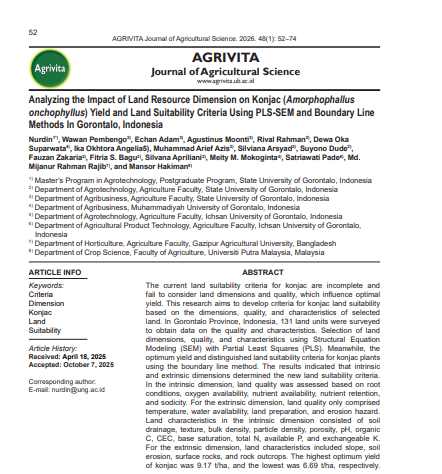
Nurdin1*), Wawan Pembengo2), Echan Adam3), Agustinus Moonti3), Rival Rahman2), Dewa Oka Suparwata4), Ika Okhtora Angelia5), Muhammad Arief Azis2), Silviana Arsyad2), Suyono Dude2), Fauzan Zakaria2), Fitria S. Bagu2), Silvana Apriliani2), Meity M. Mokoginta4), Satriawati Pade6), Md. Mijanur Rahman Rajib7), and Mansor Hakiman8)
1) Master’s Program in Agrotechnology, Postgraduate Program, State University of Gorontalo, Indonesia
2) Department of Agrotechnology, Agriculture Faculty, State University of Gorontalo, Indonesia
3) Department of Agribusiness, Agriculture Faculty, State University of Gorontalo, Indonesia
4) Department of Agribusiness, Muhammadiyah University of Gorontalo, Indonesia
5) Department of Agrotechnology, Agriculture Faculty, Ichsan University of Gorontalo, Indonesia
6) Department of Agricultural Product Technology, Agriculture Faculty, Ichsan University of Gorontalo, Indonesia
7) Department of Horticulture, Agriculture Faculty, Gazipur Agricultural University, Bangladesh
8) Department of Crop Science, Faculty of Agriculture, Universiti Putra Malaysia, Malaysia
Abstract
The current land suitability criteria for konjac are incomplete and fail to consider land dimensions and quality, which influence optimal yield. This research aims to develop criteria for konjac land suitability based on the dimensions, quality, and characteristics of selected land. In Gorontalo Province, Indonesia, 131 land units were surveyed to obtain data on the quality and characteristics. Selection of land dimensions, quality, and characteristics using Structural Equation Modeling (SEM) with Partial Least Squares (PLS). Meanwhile, the optimum yield and distinguished land suitability criteria for konjac plants using the boundary line method. The results indicated that intrinsic and extrinsic dimensions determined the new land suitability criteria. In the intrinsic dimension, land quality was assessed based on root conditions, oxygen availability, nutrient availability, nutrient retention, and sodicity. For the extrinsic dimension, land quality only comprised temperature, water availability, land preparation, and erosion hazard. Land characteristics in the intrinsic dimension consisted of soil drainage, texture, bulk density, particle density, porosity, pH, organic C, CEC, base saturation, total N, available P, and exchangeable K. For the extrinsic dimension, land characteristics included slope, soil erosion, surface rocks, and rock outcrops. The highest optimum yield of konjac was 9.17 t/ha, and the lowest was 6.69 t/ha, respectively.
Keywords: Criteria; Dimension; Konjac; Land; Suitability
Integrated land suitability assessment and management strategies for sustainable agriculture on mohupomba island, Indonesia
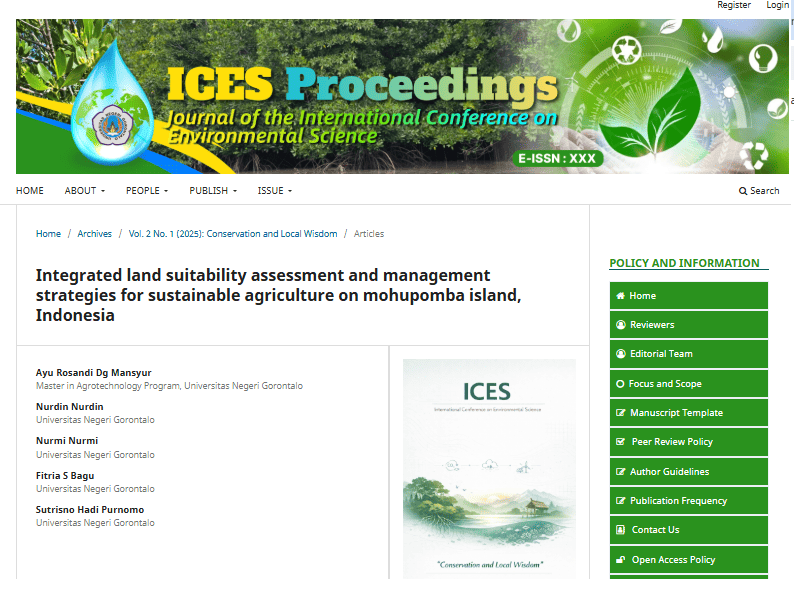
Ayu Rosandi Dg Mansyur (Master in Agrotechnology Program, Universitas Negeri Gorontalo)
Nurdin (Universitas Negeri Gorontalo)
Nurmi (Universitas Negeri Gorontalo)
Fitria S Bagu (Universitas Negeri Gorontalo)
Sutrisno Hadi Purnomo (Universitas Negeri Gorontalo)
Abstract
Land suitability assessment is fundamental to ensuring productive and sustainable agricultural development. This study aimed to evaluate land characteristics, determine land suitability, and formulate strategic management directions for sustainable agriculture on Mohupomba Island, Boalemo Regency. Field surveys were conducted using a grid sampling technique at 11 observation points. Soil physicochemical properties were analyzed in the laboratory, and climatic data were incorporated into the assessment. Land suitability was evaluated using two approaches: the Khiddir method (1986) and the Rabia method (2013). The results reveal heterogeneous land characteristics across the island. Soil texture ranges from sandy to clay loam, with moderately rapid to slow drainage conditions. Soil chemical analysis indicates neutral to slightly acidic pH, low salinity, variable organic matter content (low to high), low to moderate nitrogen, moderate phosphorus, and low to moderate available potassium (K2O). Land suitability classification based on the Khiddir method identified categories ranging from Unsuitable (N) to Very Suitable (S1), with soil fertility (f) as the primary limiting factor. In contrast, the Rabia method classified land into Marginally Suitable (S3) to Very Suitable (S1), with climate (c) identified as the main constraint. Overall, Mohupomba Island demonstrates significant potential for sustainable agricultural development, although suitability levels vary depending on land characteristics and climatic conditions. Recommended management strategies include site-specific organic and inorganic amendments to enhance soil fertility, implementation of soil and water conservation practices, and the development of climate-adaptive, agro-ecotourism-based farming systems.
Pelatihan Penentuan Dosis Pupuk Okganik Spesifik Lokasi pada Tanaman Hortikultura di Kelompok Tani Moawota Desa Bulotalangi Kabupaten Bone Bolango
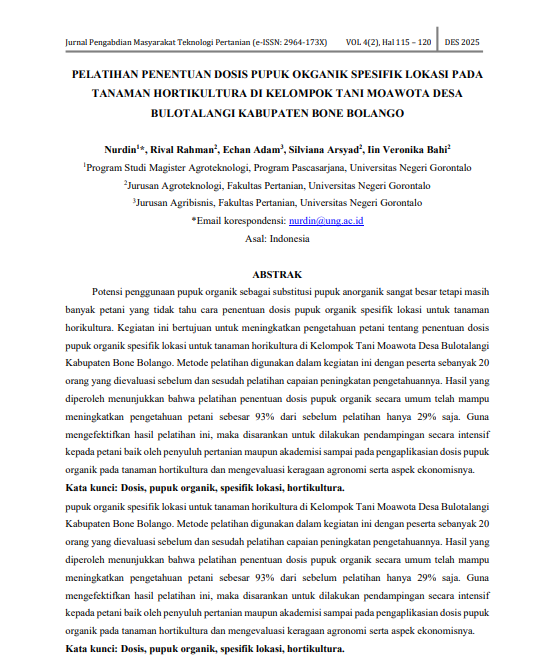
Nurdin1, Rival Rahman2, Echan Adam3, Silvana Apriliani2, Iin Veronika Bahi1
1Program Studi Magister Agroteknologi, Program Pascasarjana, Universitas Negeri Gorontalo
2Jurusan Agroteknologi, Fakultas Pertanian, Universitas Negeri Gorontalo
3Jurusan Agribisnis, Fakultas Pertanian, Universitas Negeri Gorontalo
Abstract
The potential for using organic fertilizer as a substitute for inorganic fertilizer is enormous, but many farmers still do not know how to determine site-specific organic fertilizer dosages for horticultural crops. This activity aims to increase farmers' knowledge about determining site-specific organic fertilizer dosages for horticultural crops in the Moawota Farmers Group, Bulotalangi Village, Bone Bolango Regency. The training method used in this activity was with 20 participants who were evaluated before and after the training for their knowledge improvement achievements. The results obtained showed that the training on determining organic fertilizer dosages in general has been able to increase farmers' knowledge by 93% from only 29% before the training. To make the results of this training more effective, it is recommended that intensive mentoring be provided to farmers by both agricultural extension workers and academics until the application of organic fertilizer dosages on horticultural crops and evaluation of their agronomic performance and economic aspects.
Evaluasi Kesesuaian Lahan untuk Jagung Varitas Hibrida dan Komposit di Kecamatan Bolaang Uki Kabupaten Bolaang Mongondow Selatan

Moh. Rapli Djibran (State University of Gorontalo)
Nurdin (State University of Gorontalo)
Suyono Dude (State University of Gorontalo)
Abstract
Penelitian ini bertujuan menentukan kelas kesesuaian lahan dan menilai kelayakan usahatani jagung hibrida dan komposit. Lokasi penelitian di Kecamatan Bolaang Uki, Kabupaten Bolaang Mongondow Selatan, Provinsi Sulawesi Utara yang dimulai Maret-Mei 2024 dengan menggunakan metode survei fisiografi. Teknik evaluasi lahan menggunakan pemadanan antara kriteria kesesuaian lahan untuk jagung dengan karakteristik dan kualitas lahan setempat. Hasil penelitian membuktikan bahwa kelas kesesuaian aktual untuk jagung hibrida dan komposit di Kecamatan Bolaang Uki hanya tergolong kelas tidak sesuai (N) semuanya dengan faktor pembatas kapasitas tukar kation (KTK) dan kedalaman tanah. Setelah dilakukan perbaikan faktor pembatas KTK tanah, maka secara potensial kelas kesesuaian lahan untuk jagung hibrida sudah menjadi cukup sesuai (S2) sebesar 62,49% pada satuan lahan (SL) 1, 2, 3, 4, 6, dan 7, sementara SL sisanya tetap kelas N. Sedangkan untuk jagung komposit, selain naik kelas S2 sebesar 15,60% pada SL 1, 2, dan 3, juga naik kelas sesuai marjinal (S3) sebesar 46,88% pada SL 4, 6, dan 7. Sisa SL tetap kelas N. Usahatani jagung hibrida dan komposit menguntungkan karena nilai R/C > 1.
Morphology, Characteristic and Soil Classification of Paddy Field in The Pinogu Plateau, Bone Bolango Regency

Ismail Yusuf (Universitas Negeri Gorontalo)
Nurdin (Universitas Negeri Gorontalo)
Muhammad Arief Azis (Universitas Negeri Gorontalo)
Rival Rahman (Universitas Negeri Gorontalo)
Abstract
Paddy fields are the main source of rice production in Pinogu District, thus supporting food security in this district, but have not been managed based on the soil properties. The diversity of morphology, characteristics, and soil classification on the Pinogu Plateau is the aim of this research. Three pedon paddy fields (IY1, IY2, and IY3) in one topososequence had their profiles described using a soil survey method at a scale of 1:5,000, including matrix color, structure, and soil consistency. Soil samples were taken from each horizon in each profile and analyzed in the laboratory for: texture (sand, clay, silt), bulk density, porosity, pH, C-organic, cation exchange capacity, base saturation, and salinity. Next, soil pedons were classified using a soil taxonomy system starting from Order level to Family level. The research results showed that the paddy fields on the Pinogu plateau had developed with the presence of horizon structuring (Ap-Bt) on the topososequences, but the paddy fields on the upper and middle slopes were more developed than the paddy fields on the lower slopes. The Pinogu Plateau was included in the isohyperthermic of soil temperature regimes and the udic of soil moisture regimes. The paddy field on the upper slopes was classified as Typic Humudepts, rather fine, active, isohyperthermic., meanwhile the paddy field on the middle slope was classified as Fluventic Humudepts, rather fine, active, isohyperthermic., and the paddy field on the lower slopes was classified as Entic Humudepts, rather fine , super active, isohyperthermic. This classification of paddy fields has implications for specific instructions for soil management, so that management of paddy fields that is in accordance with the characteristics and type of soil will increase the productivity of paddy fields in the future.
Kategori
- Abstract 2006
- Abstract 2009
- Abstract 2011
- Abstract 2012
- Abstract 2013
- Abstract 2014
- Abstract 2016
- Abstract 2018
- Abstract 2019
- Abstract 2020
- Abstract 2021
- Abstract 2022
- Abstract 2023
- Abstract 2024
- Abstract 2025
- Abstract 2026
- Buku
- Kunjungan Luar Negeri
- Mata Kuliah
- Pengukuhan Guru Besar, Prof. Dr. Nurdin, SP, MSi
- Profesi Ir
- Project 2009
- Project 2010
- Project 2013
- Project 2018
- Project 2019
- Project 2020
- Project 2021
- Project 2022
- Project 2023
- Project 2024
- Project 2025
- Publikasi Ilmiahku
- Soil Scientist from Gorontalo
- Tugas Pembantuan sebagai Kepala Dinas Pertanian Kabupaten Boalemo
Arsip
Blogroll
- a-SintaID
- b-Google Scholar
- c-Scopus ID
- d-Web of Science (WoS) ID
- e-ResearchGate
- f-Academia.edu
- g-SciProfiles
- h-Loop ID
- i-LinkedIn
- j-OrcidID
- k-figshare
- l-Youtube
- m-Twitter
- n-Facebook
- o-Universitas Negeri Gorontalo
- p-BIMA-Kemendikbud RI
- q-FAPERTA UNG
- r-LP2M UNG
- s- LP3M UNG
- t-SIMPPM UNG
- u-SIMLIT UNG
- v-Rispro LPDP
- w-BRIIN
- x-PDDIKTI
- y-GRS BPDPKS
- z-kampusmerdeka
- z1-ANJANI
- z10-MyASN
- z10-SIAT UNG
- z11-Aplikasi SIAGA
- z12-SPADA Indonesia
- z13-SISTER
- z14-tesaurus.kemdikbud
- z15-UKBI
- z16-typoonline
- z17-Turnitin
- z18-Zetero
- z2-eHAKI
- z20-Himpunan Ilmu Tanah Indonesia(HITI)
- z21-BKN
- z21-Kementan RI
- z22-BPS Provinsi Gorontalo
- z23-BPS Kabupaten Boalemo
- z24-BPS Kabupaten Bone Bolango
- z25-BPS Kabupaten Gorontalo
- z26-BPS Kabupaten Gorontalo Utara
- z27-BPS Kabupaten Pohuwato
- z3-Arjuna
- z4-DIKTI
- z5-GARUDA Dikti
- z6-SIM Karier dan SDM Kemendikbud
- z7-KBBI
- z8-Kedaireka
- z9-RAMA